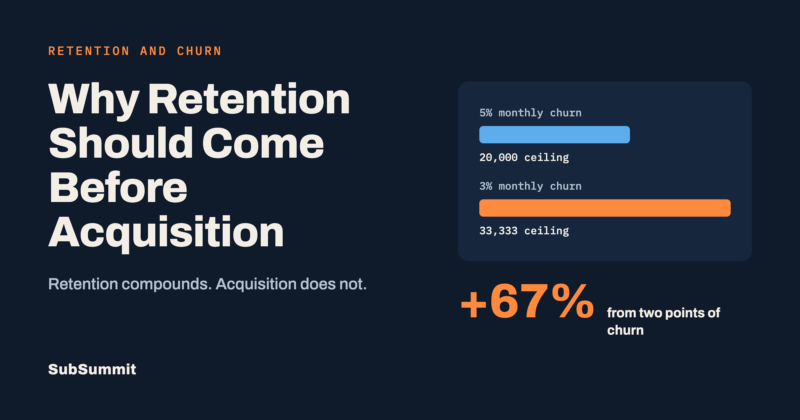
Retention should come before acquisition because retention compounds and acquisition does not. Acquisition adds a fixed number of subscribers each month. Retention determines what fraction of every past month’s acquisition is still there. That difference is multiplicative, which is why two percentage points of monthly churn separates two otherwise identical businesses by 67% at steady state.
The first move in any retention program is not a product change. It is splitting your churn number into voluntary churn and involuntary churn, because those are two different problems with different owners, different fixes, and different timelines.
The math, worked
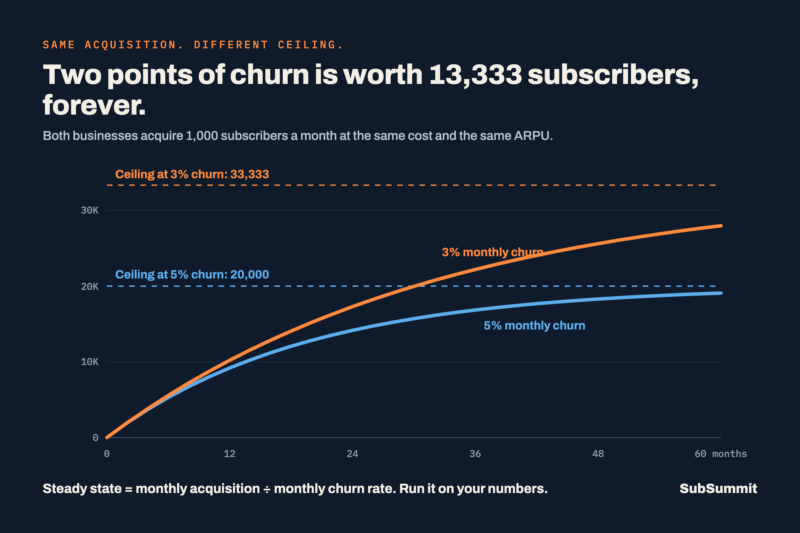
Take two businesses acquiring 1,000 subscribers per month at identical cost, with identical average revenue per user. The only difference is monthly churn: Business A at 5%, Business B at 3%.
Subscriber count after n months is the acquisition rate multiplied by the sum of the retention series, which is A times (1 minus r to the n) divided by (1 minus r), where r is monthly retention.
| Month | Business A, 5% churn | Business B, 3% churn | Gap |
| 12 | 9,193 | 10,206 | 11% |
| 24 | 14,160 | 17,287 | 22% |
| 36 | 16,844 | 22,199 | 32% |
| Steady state | 20,000 | 33,333 | 67% |
Steady state is the ceiling, reached when monthly losses equal monthly acquisition. It equals acquisition rate divided by churn rate. Business A tops out at 20,000 subscribers forever, no matter how long it runs. Business B tops out at 33,333.
To reach Business B’s ceiling, Business A would have to acquire 1,667 subscribers per month instead of 1,000. That is a 67% increase in acquisition spend, permanently, to buy what two points of churn would have delivered.
There is no acquisition tactic that produces that result for that money. Reducing cost per acquisition by 40% takes channel work, creative work, and a testing period that costs more before it costs less. Two points of churn is frequently one billing configuration change and one onboarding change.
Run this on your own numbers before the next budget approval. Steady state base equals monthly acquisition divided by monthly churn rate. It takes one minute and most teams have never done it.
Split the number first
The reason retention programs stall is that teams work a single blended churn figure. It is two numbers with almost nothing in common.
Voluntary churn is a subscriber choosing to leave. The cause sits in product fit, price, experience, or a change in their circumstances. Fixing it requires product and pricing work measured in quarters.
Involuntary churn is a subscriber removed by a failed payment. They decided nothing. Their card expired, was reissued, was declined by the issuer, or the account had insufficient funds on the day you attempted the charge. Fixing it requires billing configuration and communication work measured in weeks.
Blend them and you will build a product roadmap for a payments problem. This happens constantly.
Instrument the split like this: at the point a subscription terminates, tag the terminating event with its cause. Cancellation requested. Payment failed and dunning exhausted. Refund and cancellation. Chargeback. Expired without renewal. If your billing platform does not expose the terminating cause, that is the first ticket to write.
Work involuntary churn first
Involuntary churn is the cheapest churn to reduce because those subscribers already demonstrated intent. They bought. The transaction failed.
Understand what actually fails
Card on file transactions fail for a small set of recurring reasons, and the reasons split into two classes that require opposite responses.
Soft declines are recoverable. Insufficient funds, issuer temporarily unavailable, transaction limit exceeded, do not honor. These represent a state that may change. Retry them.
Hard declines are terminal. Card reported lost or stolen, account closed, invalid card number, pick up card. These represent a state that will not change. Retrying them accomplishes nothing, consumes retry attempts against card network limits, and in some cases carries penalty exposure. Route these straight to the customer for a new payment method.
Your processor returns a reason code on every decline. Pull the last ninety days of failed recurring transactions, group them by code, and split them into soft and hard. That single query usually reveals that a meaningful share of retry volume is being spent on declines that were never going to succeed.
What actually fails, by the numbers
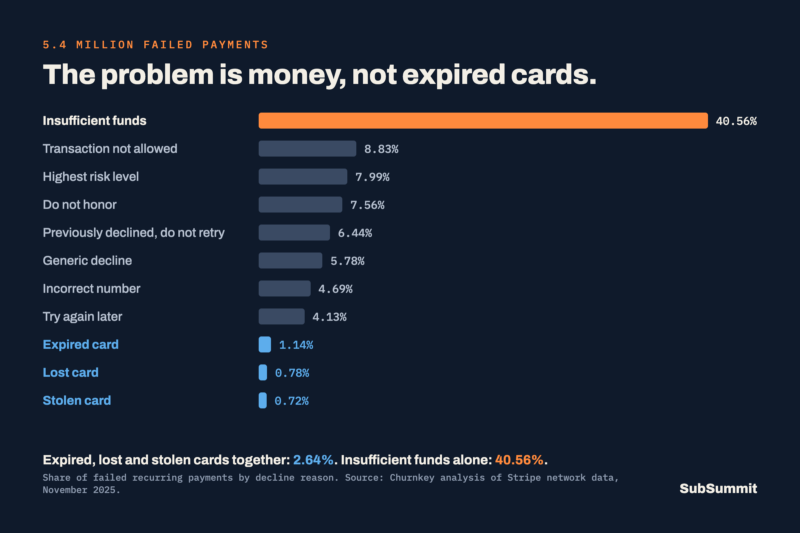
Churnkey analyzed 5.4 million failed payments across the Stripe network. The distribution is not what most retention advice assumes.
| Decline reason | Share of failures |
| Insufficient funds | 40.56% |
| Transaction not allowed | 8.83% |
| Highest risk level | 7.99% |
| Do not honor | 7.56% |
| Previously declined, do not retry | 6.44% |
| Generic decline | 5.78% |
| Incorrect number | 4.69% |
| Try again later | 4.13% |
| Expired card | 1.14% |
| Lost card | 0.78% |
| Stolen card | 0.72% |
Source: Churnkey analysis of Stripe network data, November 2025
Read the bottom of that table. Expired cards are 1.14% of failures. Lost and stolen cards together are 1.50%. Nearly every article written about involuntary churn opens by telling you that expired cards are the problem, and the largest published dataset on the subject says they are close to a rounding error.
The actual problem is money. Insufficient funds alone is more than 40% of all failures, and it is a soft decline, which means it is recoverable by retrying at a moment when the account has been funded. That single fact should reorganize your entire recovery strategy. If insufficient funds dominates your failures, retry timing relative to deposit and payday cycles is worth more than every dunning email you will ever write.
This does not make account updater services useless. They still address the 1.14%, they cost nothing to switch on, and network tokenization prevents that category entirely. But they are not where the volume is, and a recovery program built around card refresh alone is aimed at the wrong 2%.
One caution on the codes themselves. “Do not honor” is a catch all the issuer returns when it declines to say why, and “generic decline” is the same. Both are soft and both are retriable. “Previously declined, do not retry” at 6.44% is an explicit instruction from the network and should be routed straight to the customer.
The four fixes, in order of effort
- Turn on account updater. The card networks operate services that push updated card credentials to merchants when a card is reissued, replaced, or renumbered. Visa’s is the Visa Account Updater. Mastercard’s is the Automatic Billing Updater. Most processors expose access to these. If yours does and it is not enabled, this is a settings change, not a project, and it addresses the largest single category of involuntary churn at most subscription businesses.
- Adopt network tokenization. A network token replaces the stored card number with a token issued by the card network. Tokens update automatically when the underlying card changes, which means expiry and reissuance stop breaking your recurring charges at all. Tokenized recurring transactions also tend to see better authorization treatment from issuers. This is a genuine engineering project rather than a setting, but it is the durable version of fix one.
- Fix retry logic. Default retry configurations commonly retry at a fixed interval, at the same time of day, with the same credential. That reproduces the same decline. Better retry strategy varies three things: timing relative to typical deposit and payday cycles, time of day, and whether the credential has been refreshed since the last attempt. Retry policy should also differ by decline code class, with soft declines retried and hard declines routed out immediately.
Note that the card networks impose limits on retry attempts for declined recurring transactions, and those limits are enforced with fees for excessive attempts. Check your processor’s current guidance before setting an aggressive schedule.
- Handle authentication correctly. In markets subject to strong customer authentication requirements, recurring charges need to be set up correctly as merchant-initiated transactions with the appropriate exemption, and the initial transaction needs to be flagged as a customer-initiated transaction that establishes the stored credential mandate. Getting this wrong produces declines on charges that should have been exempt. If you sell into Europe or the UK and your recurring authorization rate is materially below your one-time checkout rate, this is the first place to look.
Then fix the communication
Pre-dunning. Email before the card expires, not after the charge fails. A subscriber who updates a credential in advance never enters the failure path at all. Trigger on stored expiry date, thirty and seven days out. This is the highest return email in the subscription lifecycle, and most brands do not send it.
Dunning sequence design. When a charge does fail, the sequence should read as a service notification, not a collections notice. The subscriber did nothing wrong. Practical rules:
- Send the first message within hours, while the context is fresh.
- Say specifically what happened and what will happen next, including the date of the next attempt and the date service ends.
- Give a single, direct link to update the payment method that does not require a full login. Every authentication step between the message and the update form costs recovery.
- Use more than one channel. Email deliverability on transactional billing messages is imperfect and SMS or in app notification recovers a meaningful share that email alone does not.
- Do not offer a discount in the first message. The subscriber was willing to pay full price and a discount converts a billing failure into a permanent margin reduction.
Measure the sequence as a funnel: charge failed, message delivered, message opened, payment method updated, charge succeeded. A single recovery rate hides whether your problem is deliverability, clarity, or update friction. Those three have completely different fixes.
How much each of these is actually worth
Churnkey’s data gives a rare look at the marginal return on each piece of the recovery stack.
On retries alone, Stripe’s built in Smart Retries recovered 51% of failed payments at an average of 5.5 days to recovery. Layering Churnkey’s own retry logic on top moved that to 55% at 4.8 days. That is a 4-point improvement, which is real money at volume but is also the honest scale of what a second vendor adds on top of a well configured processor.
On dunning email, the return decays sharply by message:
| Message | Recovery contribution | Open rate |
| Dunning email 1 | 2.8% | 55.8% |
| Dunning email 2 | 1.9% | 48.0% |
| Dunning email 3 | 1.7% | 39.7% |
| Dunning email 4 | 1.5% | 29.8% |
| Dunning email 5 | 1.5% | 20.6% |
Source: Churnkey, November 2025
Two things to take from this. The first message does the most work, which argues for sending it fast and writing it carefully rather than building a long sequence. And the whole email sequence contributes single digit recovery percentages against a retry engine doing more than half the job on its own. Retries first, email second. Most teams have that backwards, because email is the part the marketing team owns.
Churnkey reports recovering 70% of detected involuntary churn using retries, a failed payment wall, and dunning together. Treat that as a vendor figure from a vendor’s own customers, which is what it is, but the ordering it implies is consistent with the underlying data.
Then work the shape of the curve
After billing, the highest yield work sits where the churn curve is steepest, and that is almost always early.
Find the cliff
Plot retention by month of tenure rather than by calendar month. Nearly every subscription business shows a steep drop across the first two to four cycles and then a flattening. The flattening level is the asymptote and it represents the share of each cohort that becomes durable.
Plot the hazard rate alongside it, which is the probability of churning in a given month conditional on having survived to that month. The hazard rate shows exactly where risk concentrates. Most businesses find a spike at the first renewal and a second smaller spike around the twelve-month mark.
Prioritize with expected value, not intuition
Every retention idea can be sized before you build it:
Expected annual revenue impact = affected population per year × expected change in retention at that point × ARPU × expected remaining months
Run this on your three candidate interventions and the ranking is usually not what the team assumed. Improving month one retention by two points typically outweighs improving month eighteen retention by ten, because the month one population is far larger and the recovered subscribers have a longer remaining life. Moving the asymptote outperforms both, because the asymptote applies to every future month of every future cohort.
The three things to check in the early window
Time to first value. How many days pass between purchase and the moment the product does the thing it was bought for. Shorten it. For a physical subscription this is often a shipping and expectation setting problem rather than a product problem.
Second cycle conversion. Completing cycle two is the strongest early signal available. Instrument it, report it weekly, and treat a drop as a production incident rather than a metric. Stay AI’s CEO Gina Perrelli has said publicly that for the Shopify subscription brands they work with, the highest concentration of cancellations falls between the first and second order, which is the same cliff showing up from the vendor side.
The activation behavior. Identify it empirically rather than assuming it. Take subscribers at a fixed tenure, split them into retained and churned, and compare which early behaviors differ most sharply between the groups. That is a correlation, not a cause, so treat the output as a hypothesis to test rather than a target to optimize directly. Optimizing a correlated behavior without testing causation is how teams end up pushing a metric that moves while retention does not.
The cancel path is a data source, not a wall
Friction in the cancel flow does not retain subscribers. It converts cancellations into chargebacks, support tickets, negative reviews, and in several jurisdictions regulatory exposure, since a growing number of markets require the cancellation path to be as easy as the signup path.
Design it as an instrument instead:
Ask one question, with a fixed taxonomy. Too expensive. Not using it enough. Product issue. Found an alternative. Temporary situation. Fixed options, not free text, because free text is unanalyzable at volume and the taxonomy is what lets you route the response.
Route the offer to the reason. Price objection routes to a lower tier or a pause, not a permanent discount. Low usage routes to a smaller plan or a skip. Temporary situation routes to a pause with a defined restart date. A product issue routes to support and generates a ticket. One generic save offer to everyone underperforms a routed one and costs more margin.
Offer pause before you offer discount. A pause preserves the relationship, the payment credential, and the full price. A discount permanently reduces the value of a subscriber who was previously willing to pay full price. Set a maximum pause duration and an automatic restart.
The consumer data on this is unusually strong. Recurly’s 2026 State of Subscriptions, built from 2,200 subscription businesses and 76 million subscribers, found that 38% of consumers would rather pause than cancel, that pause usage rose 337% among brands offering it, and that 75% of subscribers who paused eventually returned. The same report found that nearly one in four new subscriptions now comes from a previously cancelled customer.
That last figure reframes what churn is. If a quarter of your new subscribers are returning ones, cancellation is a state in the relationship rather than the end of it, and a win back program is not a salvage operation, it is an acquisition channel with better economics than any paid one you run.
Report save rate by reason code. This tells you which objections you can actually answer and which ones are the product telling you something.
Measuring whether any of it worked
Retention interventions are difficult to evaluate because the outcome arrives months after the change and the base is moving underneath you.
Hold out a control group. Randomly exclude a portion of eligible subscribers from the intervention. This is the only way to distinguish the effect of the change from seasonality, mix shift, and everything else happening concurrently. Teams skip this constantly and then argue for a year about whether the program worked.
Compare cohorts at equal tenure, not at equal calendar dates. A cohort acquired in a promotional month is not comparable to one acquired in a normal month and comparing them at the same calendar date compares different tenures.
Set the measurement window before you start. Billing fixes show up in weeks. Onboarding changes show up in one to two cycles. Asymptote changes take a quarter or more to become visible.
Watch for mix shift. If a change improves retention while also reducing acquisition volume, you may have improved the average by filtering out marginal subscribers rather than by retaining anyone additional. Check the acquisition number alongside the retention number, always.
The order of operations
Retention before acquisition does not mean stop acquiring. It means fix the leak before you turn up the tap, in this sequence:
- Split the churn number. Tag terminating events by cause. Voluntary and involuntary become separate lines on every report.
- Audit declines by reason code. Split soft from hard. Stop retrying hard declines.
- Enable account updater. Settings change. Do it this week.
- Fix retry logic. Vary timing, time of day, and credential freshness. Differentiate by decline class.
- Ship pre dunning. Thirty and seven days before stored expiry.
- Rebuild the dunning sequence. Service tone, single click update, multi channel, measured as a funnel.
- Plot retention by tenure and hazard rate by tenure. Find the cliff.
- Size interventions by expected value. Population times delta times ARPU times remaining months.
- Rebuild the cancel path as a routed instrument with a fixed reason taxonomy.
- Then scale acquisition, against a curve that now holds.
Steps one through six are a quarter of work for a team of two and require no product roadmap slot. Steps seven through nine are the quarter after. Step ten works better permanently because of all of it.
Frequently asked questions
What is involuntary churn?
Involuntary churn is subscriber loss caused by a failed payment rather than a cancellation decision. Common causes are expired or reissued cards, issuer declines, insufficient funds, and closed accounts. It is tracked separately from voluntary churn because it is fixed with billing configuration and communication rather than with product or pricing changes.
Why should retention come before acquisition?
Because retention compounds and acquisition does not. Steady state subscriber count equals monthly acquisition divided by monthly churn rate, so reducing churn from 5% to 3% raises the ceiling by 67% at unchanged acquisition spend. Matching that gain through acquisition alone would require a permanent 67% increase in acquisition budget.
How do you reduce involuntary churn?
Enable a card network account updater service, adopt network tokenization so reissued cards do not break stored credentials, differentiate retry logic between soft and hard declines, send pre dunning notifications before stored cards expire, and rebuild the dunning sequence as a service message with a single click update path measured as a funnel.
What is the difference between a soft decline and a hard decline?
A soft decline reflects a temporary condition such as insufficient funds or an issuer being unavailable, and it may succeed on retry. A hard decline reflects a permanent condition such as a closed account or a card reported lost, and it will not succeed on retry. Retrying hard declines consumes retry attempts against card network limits without recovering revenue.
What is a good subscription retention rate?
A single benchmark is misleading because retention varies widely by category, price point, and billing interval. The more useful question is whether your survival curve flattens and at what tenure. A curve that flattens by the third or fourth cycle indicates the product has become a habit. A curve that continues declining indicates it has not.
Should you make it hard to cancel a subscription?
No. Cancellation friction converts cancellations into chargebacks, support volume, and negative reviews, and a growing number of markets legally require the cancellation path to be as simple as the signup path. Design the cancel flow as an instrument instead, with a fixed reason taxonomy and a save offer routed to the stated reason.
How do you measure whether a retention change worked?
Hold out a randomly selected control group from the intervention and compare cohorts at equal tenure rather than at equal calendar dates. Without a holdout, the effect of the change cannot be separated from seasonality and concurrent marketing activity. Also check acquisition volume, since apparent retention gains can come from filtering out marginal subscribers.
The leak is almost always cheaper to fix than the growth is to buy. Most teams learn that after they have already spent the quarter.